
Getting Started
Start with a small, dependable kit. Good paper, a restrained palette, and one or two reliable brushes matter more than buying too much too soon.
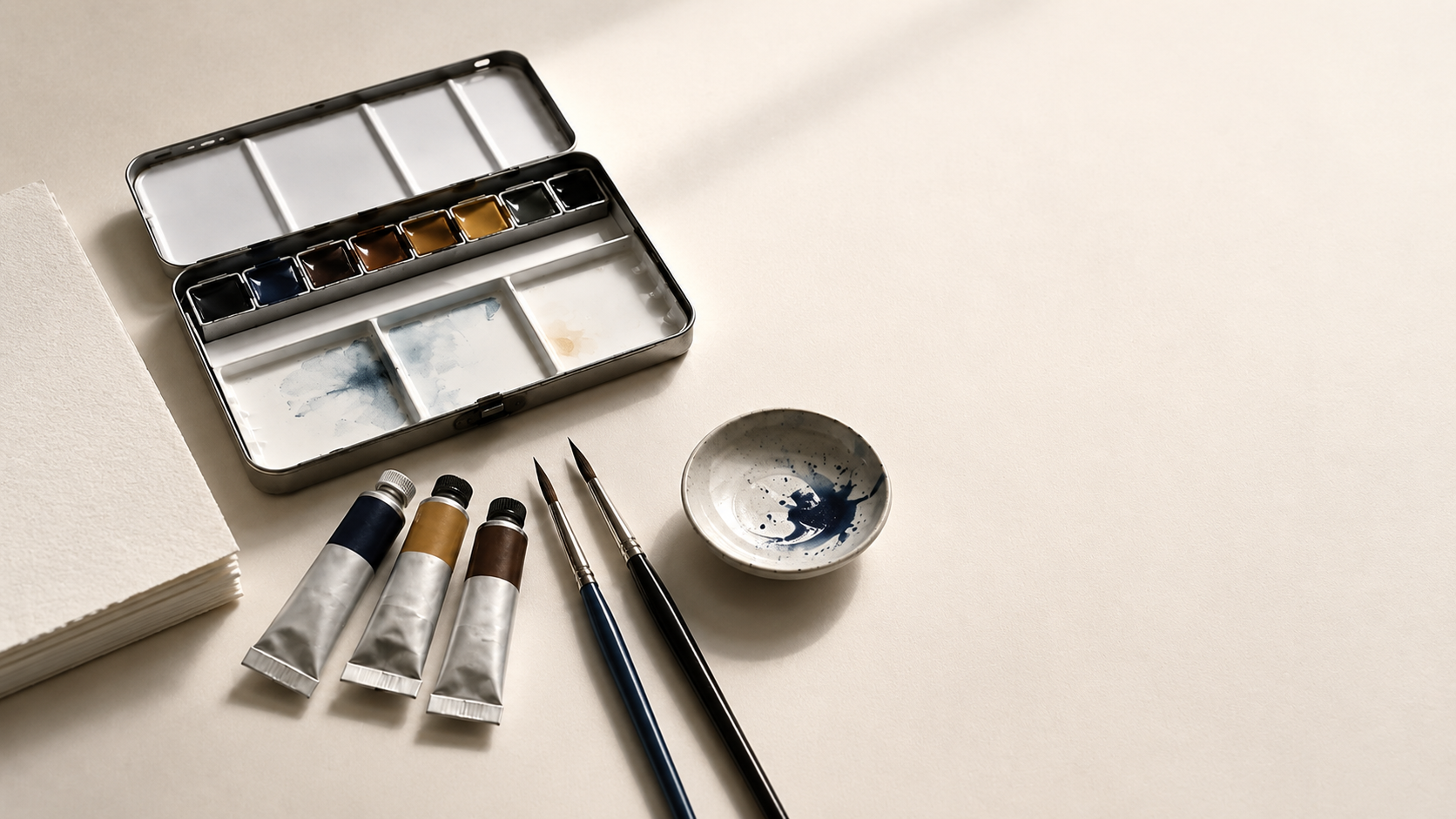
Start here
Which paper specifications matter, which brands are worth buying, and where the standard advice leads beginners astray.
The smallest sensible starting kit, what to spend on first, and what can wait until later.
The recurring early problems that make beginners stop, and the specific fixes that solve them.
At a glance
Paper matters more than anything else in your kit. The most common reason early work looks disappointing is paper that cannot hold a wash. Wood-pulp paper buckles, resists lifting, and produces edges that no technique can rescue. Switching to 300gsm cold press cotton paper produces visible improvement before technique changes at all.
A limited palette is not a compromise. Six well-chosen single-pigment colours will teach you more about mixing than twenty-four convenience mixtures. What PB29, PY43, and PR101 actually do when combined is more useful knowledge than owning every prepared green and brown on the shelf.
Water control is the first real skill. Muddy colour, cauliflower blooms, hard edges where soft ones were wanted — most of these come from too much water, too little water, or water applied at the wrong moment. They are teachable problems, not signs of incapacity.
The medium does not erase. Watercolour asks you to work light to dark, to plan your whites, and to commit to a wash before it dries. Painters arriving from acrylic or oils often struggle with this, and the struggle is normal. The articles below address it directly.
-
Watercolour supplies for beginners: what each one is for
You can begin with a few colours, suitable paper, one brush and a plate. Here is what each supply does, and when the rest is worth adding.
-
How long to wait between watercolour layers
There is no reliable number of minutes between watercolour layers. The look and feel of the paper give a better answer than the clock.
-
How much water to use in watercolour: palette, brush and paper
There is no fixed ratio of water to paint. Judge the mixture, the brush and the paper by sight, then record your own paints with a strength strip.
-
Returning to watercolour after a long gap: what has changed and what has not
If you are returning to watercolour after years away, the instincts you built are still there. What has not kept pace is your picture of the materials, and that gap is worth closing before you spend any money.
-
The five mistakes watercolour beginners make in the first month and how to avoid them
Most early frustrations with watercolour come down to the same handful of problems. Understand what they are and why they happen, and the medium becomes considerably less mysterious.
-
Best watercolour set for beginners: what to buy and what to leave out
By the end of this article you will know exactly what to spend your money on, what to ignore, and why the conventional advice about starter kits is sometimes wrong.
Choose your starting point
Recommended materials
These are the four things a new painter in the UK should own before anything else. Paper first. Everything else becomes easier once the surface is doing its job.

What matters, and what does not
Watercolour is transparent. Each layer lets light through to the paper beneath, which is what gives the medium its luminosity and also what makes mistakes visible in a way opaque media do not. The practical consequence is that light values must be preserved from the start, not painted over at the end. Working light to dark is not a stylistic preference. It is how the medium functions.
Paper surface matters as much as paper weight. Cold press has a slight texture that slows water movement and creates natural variation in washes, which is why it is the right starting point for most beginners. Hot press is smoother and better suited to controlled, detailed work. Rough exaggerates granulation and suits looser approaches.
Pigment codes appear throughout these guides. PB29 is French ultramarine, PY43 is yellow ochre, PR101 is light red. Knowing what you are actually working with tells you how a colour will mix, whether it will granulate, and whether it will last. The Handprint pigment database (opens in new tab) is the best independent reference for this.
On timing: when you apply paint matters as much as how. Wet into wet produces soft edges and spread. Wet into dry produces defined edges and control. The moment between the two, when paper is damp rather than wet or dry, is where blooms form and washes go wrong. Most early frustration comes from working at the wrong stage of drying, not from a lack of ability.
Recommended materials
These are the four things a new painter in the UK should own before anything else. Paper first. Everything else becomes easier once the surface is doing its job.
What matters, and what does not
Watercolour is transparent. Each layer lets light through to the paper beneath, which is what gives the medium its luminosity and also what makes mistakes visible in a way opaque media do not. The practical consequence is that light values must be preserved from the start, not painted over at the end. Working light to dark is not a stylistic preference. It is how the medium functions.
Paper surface matters as much as paper weight. Cold press has a slight texture that slows water movement and creates natural variation in washes, which is why it is the right starting point for most beginners. Hot press is smoother and better suited to controlled, detailed work. Rough exaggerates granulation and suits looser approaches.
Pigment codes appear throughout these guides. PB29 is French ultramarine, PY43 is yellow ochre, PR101 is light red. Knowing what you are actually working with tells you how a colour will mix, whether it will granulate, and whether it will last. The Handprint pigment database (opens in new tab) is the best independent reference for this.
On timing: when you apply paint matters as much as how. Wet into wet produces soft edges and spread. Wet into dry produces defined edges and control. The moment between the two, when paper is damp rather than wet or dry, is where blooms form and washes go wrong. Most early frustration comes from working at the wrong stage of drying, not from a lack of ability.
What do I need to start watercolour painting in the UK?
A 300gsm cold press cotton paper pad, a basic set of watercolour paints, one good round brush, two jars of water, a palette with wells, masking tape, and a firm board to tape the paper to. This is a complete kit. Anything beyond it is a refinement, not a requirement.
What is the best watercolour paper for beginners?
Start with 300gsm cold press paper made from 100% cotton. Saunders Waterford and Bockingford are both widely available from UK suppliers and perform well at this stage. Avoid wood-pulp papers and mixed-media pads — they buckle badly, resist lifting, and do not show you what the medium can actually do.
Should a beginner use pans or tubes?
Either works. Pans are more convenient for small-scale work and travel, require no preparation, and avoid waste. Tubes allow you to load a palette with fresh paint and mix larger quantities of colour for bigger washes. For a first purchase, a half-pan set is the more practical choice. For painters who work at A3 or larger, tubes become more useful.
Why do my watercolours look muddy?
Usually one of three things. Too many pigments mixed together, particularly two or more that each already contain multiple pigments. Working into paint that is partially dry rather than fully wet or fully dry. Overworking a wash with repeated brushstrokes after it has been laid. Single-pigment paints, a decisive approach to laying washes, and leaving them alone once down are the most direct fixes. The full article on muddy colour covers each cause in more detail.
Why is my watercolour paper buckling?
Paper buckles when it absorbs more water than its weight can hold flat. The solution is heavier paper — 300gsm is the practical minimum — combined with taping all four edges of a loose sheet to a firm board before starting. For very wet work, a watercolour block (sheets glued on all four sides) eliminates the problem almost entirely. Warping paper on a light pad is a materials problem, not a technique problem.
How long does it take to learn watercolour?
Enough to produce work you are reasonably pleased with: a few months of regular practice, assuming decent materials. The painters who say they are still learning after decades are not being modest. The ceiling is high, and the questions become more interesting the further you go.
Is watercolour harder than other painting media?
It requires a different kind of discipline — planning ahead, committing to marks, working with drying time rather than against it. Painters coming from acrylic, where overpainting is straightforward, often find the early stages demanding. The adjustment is real but not permanent. Once the basic logic of the medium is clear, the transparency and immediacy that made it feel difficult become its most useful qualities.