
Materials · Guide
Two cotton papers, several different choices. Compare the sheet you will buy before choosing the name on its wrapper.
6 min read
If you already enjoy painting on Saunders Waterford, Arches is not an automatic next step. The same applies in reverse. Both are established cotton watercolour papers, and neither name tells you which surface, white or format you will prefer.
If you are choosing between them for the first time, start with 300gsm and the surface you normally use. Compare the size and format you can actually buy, then the delivered cost. If both fit, a small quantity of the less expensive option is a reasonable first purchase. The more expensive one needs a reason beyond its reputation.
This comparison uses the mills’ published specifications. It separates the differences you can establish before ordering from the handling questions you can only settle with the paper in front of you.
At a glance
Already happy with one? Keep it unless the alternative offers a useful format, a surface you want to explore or a better buying option.
Comparing for the first time? Match 300gsm, surface category and format before comparing prices.
Looking at sizing? Saunders is internally sized and has a gelatin-sized surface; Arches describes natural gelatin sizing through the sheet. These descriptions do not establish a performance winner.
Choosing a white? The names are not a shared colour scale. Do not assume High White and bright white look identical.
Ordering online? Check the selected variant rather than the first photograph or price on a range page.
Choose a paper to try
Your choice applies to both papers. Match weight, surface, dimensions and format before comparing the delivered cost.
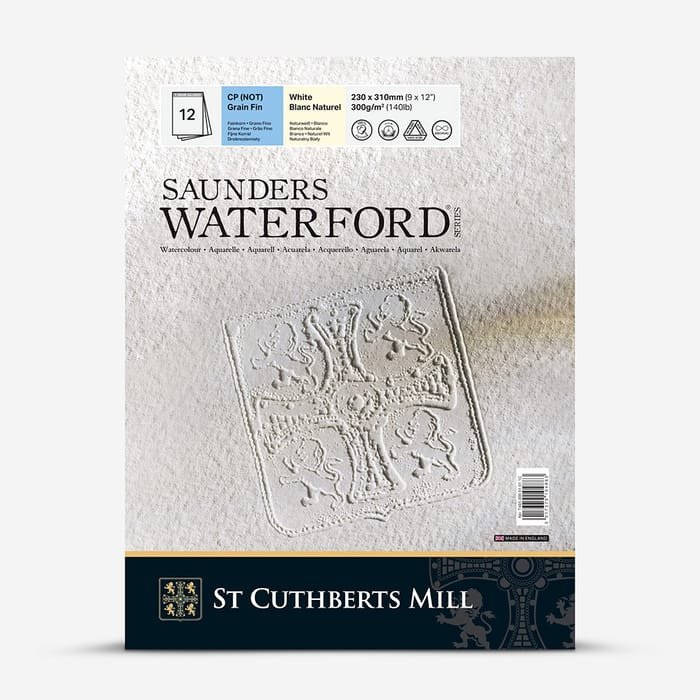
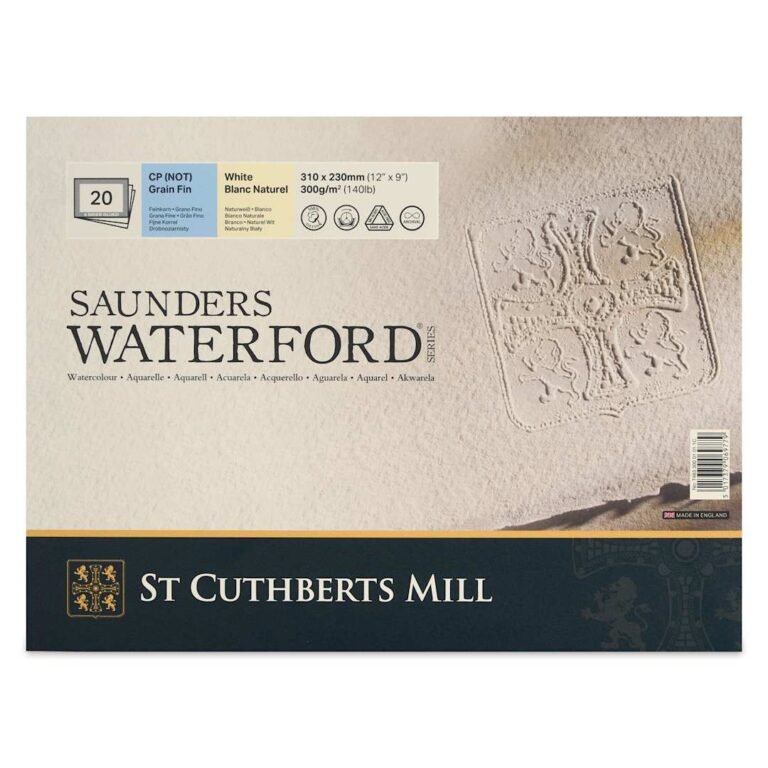
Saunders Waterford
Saunders Waterford
300gsm · cold pressed · 9 × 12 in · 100% cotton
UK: a 12-sheet gummed pad. US: a 20-sheet block. Both links let you buy this cotton paper, but the formats are not equivalent.
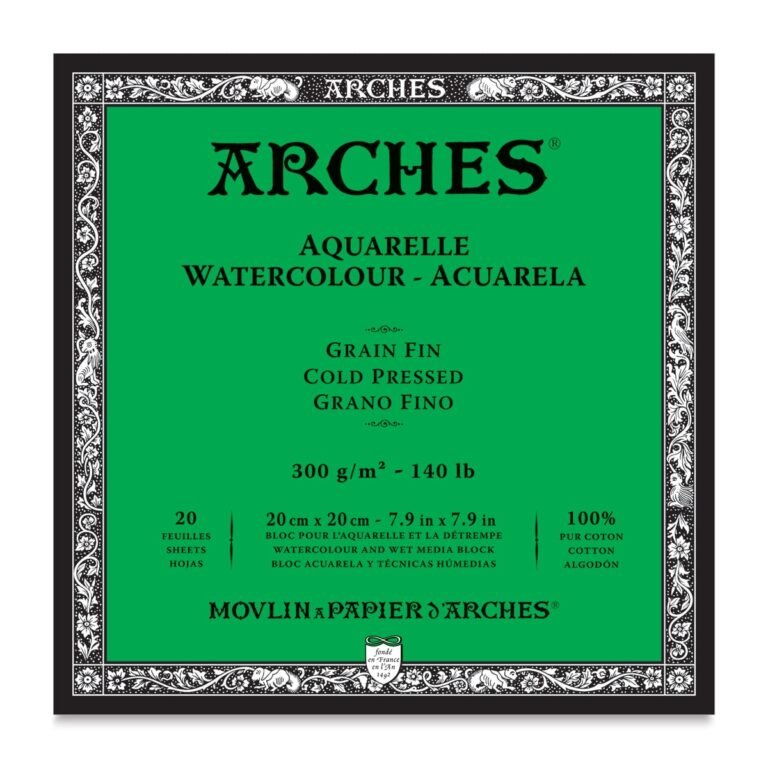
Arches Aquarelle
Arches Aquarelle block
300gsm · cold pressed · cotton
A glued block for painting without removing each sheet first. Choose 300gsm and cold pressed, then compare size and sheet count.
 UK
Range page: select 300gsm / 140 lb and Cold Pressed, then your size. The photograph illustrates the format.
 US
Range page: select 300gsm / 140 lb and Cold Pressed, then your size. The photograph illustrates the format.
What the specifications establish
| Choice | Saunders Waterford | Arches Aquarelle |
|---|---|---|
| Fibre | 100% cotton | 100% cotton |
| Manufacture | Cylinder mould | Cylinder mould |
| Published sizing description | Internal sizing plus gelatin surface sizing | Natural gelatin sizing through the sheet |
| Surfaces | Hot press, cold press / Not, rough | Hot pressed, cold pressed, rough |
| Whites | White, High White | Natural white, bright white |
| Weights listed by the mill | 190, 300, 425, 638gsm | 185, 300, 356, 640, 850gsm |
| Formats across the range | Sheets, rolls, blocks, pads | Sheets, rolls, blocks, pads |
Sources: St Cuthberts Mill’s Saunders Waterford range and Arches Aquarelle. Not every weight, white and surface is available in every format.
The table narrows the purchase. It does not tell you that one cold press texture is finer, that one sheet stays wet longer or that one releases a particular pigment more easily. Those would be separate comparisons, not deductions from the cotton label.
Sizing: a difference in description, not a ranking
St Cuthberts Mill’s technical specification identifies both internal sizing and gelatin surface sizing. Its explanation of animal ingredients describes a gelatin bath coating both sides. The mill does not name the internal sizing agent. Arches describes natural gelatin sizing through the sheet.
These descriptions establish that Saunders has internal sizing as well as a surface treatment. They do not measure wash behaviour or justify calling either paper stronger.
For a painter, the question is what happens during the work: how a wash spreads, how another layer settles, or how much colour can be lifted. Paint formulation, water load and the way the sheet has been handled also enter those decisions. Our guide to sizing in watercolour paper explains the treatment itself.
Both makers identify gelatin, so neither of these ranges is a gelatin-free choice. If that matters to you, resolve it before comparing surface or price.
Match the surface before comparing the brands
Cold press is a useful starting comparison if it is already your usual surface. Saunders also uses the label Not, meaning not hot pressed. Choose the corresponding surface category in Arches, rather than comparing a smooth sheet from one mill with a textured sheet from the other.
Matching the label is only the first step. It does not mean the textures are identical. A surface can feel different under a fine drawing line, a broad wash or a broken drybrush mark, and the preference that matters is the one connected to your painting.
For detailed work on a smooth sheet, compare hot press with hot press. For an intentionally textured surface, compare rough with rough. Buying a different surface and a different brand at the same time makes it harder to know which change you liked.
If you want to try a new texture, make that the purpose of the purchase. There is no need to frame it as replacing an inferior paper.
Choose the white with the painting in mind
The unpainted parts of a watercolour remain part of the picture. That makes the paper’s colour a material choice, especially when you leave substantial areas uncovered or work in pale washes.
St Cuthberts Mill gives its White and High White papers TAPPI whiteness values of approximately 76% and 89%. Arches names Natural white and bright white without a corresponding figure on its product page. The two ranges therefore cannot be matched numerically from these pages. Both mills state that these papers contain no optical brightening agents.
A shop photograph is useful for recognising packaging, but it cannot settle a subtle colour comparison. Lighting, photography and the screen affect what you see. If matching an existing painting or a series matters, start with the paper already used rather than selecting a substitute by its online image.
For an unfamiliar white, a sample or a small purchase is more informative than ordering a large supply on the strength of the name.
Weight and format: compare what you will use
At 300gsm there is a straightforward match between the ranges. Above that, the catalogues offer different intermediate weights: Saunders lists 425gsm, while Arches lists 356gsm. Those are choices to investigate if you want a heavier sheet, not evidence that either entire range is better.
The heaviest Saunders weight is listed by the mill as 638gsm, although some retail listings round it to 640gsm. Check the product’s stated weight and pound designation together rather than treating that small label difference as a useful performance distinction.
Format can matter more to the purchase than a small difference in weight. A pad, a block and a pack of full sheets give you different quantities and different ways of preparing the work. Our guide to blocks, pads and sheets covers those decisions.
Compare the amount of paper you can use at your normal painting size. Full sheets may be economical if you want to cut them down; a pad may suit you better if you want to open it and begin. Include delivery and any large-sheet handling charge before deciding which purchase costs less.
When changing paper makes sense
If your current paper suits your usual washes and you can buy it reliably, there is little reason to replace it simply because another name appears more often in recommendations. Familiarity has a practical value: you have already learned something about that particular surface.
Changing makes more sense when there is a specific question. Perhaps you want a different white, a block in a useful size, or a paper you can obtain locally. Those are concrete reasons to explore the alternative.
If you are moving from wood pulp to cotton, the first decision is whether that change suits your work. The cotton versus wood pulp guide owns that question. Once you have decided on cotton, Saunders and Arches are two candidates within the same broad material category.
For US orders, our Blick paper-buying guide explains the ranges and how to read the available variants. For other countries, use Where to buy. Keep the specification fixed while comparing retailers.
What the catalogues let you choose
- An intermediate heavier sheet: Saunders lists 425gsm; Arches lists 356gsm.
- A very heavy sheet: Saunders lists up to 638gsm; Arches also offers 850gsm.
- Pad binding: Saunders specifies the long edge, Arches the short side. Consider how you want the pad to open while painting.
These are concrete reasons to favour a particular product. Check which combinations of weight, surface and format the retailer actually offers.
The practical verdict
Choose Saunders Waterford if it gives you the surface, format and buying terms you want. Choose Arches on the same grounds. If you already know one works for you, that experience is a stronger reason to stay with it than a general claim that the other is superior.
For a first comparison, narrow the choice to matching 300gsm papers in your familiar surface. If neither has a specific advantage for your needs, start with a small quantity of the better-priced purchase. Spend more when you can name what the difference buys you, rather than paying for an assumed winner.