
Artists · Long read
A white figure walks between polar bears. Bubbles rise from dark water. In Edmund Dulac’s fairy-tale illustrations, the impossible has a precise and persuasive presence. Look closely, and the dream begins to reveal its arrangement.
12 min read
The first thing you notice may be the bears. Their heavy bodies cross a field of snow, one on either side of a woman whose dress seems almost as pale as their fur. Above them, stars punctuate a deep blue night. She holds something small and red in her hands.
Nothing in the scene appears hurried. The bears do not rear or snarl. The woman turns her face towards us without breaking the procession. Her trailing dress belongs to the snow, yet the tall shape of her body stands clearly against the sky. The picture offers an impossible encounter with the composure of an ordinary walk.
This is the Ice-Maiden, one of Edmund Dulac’s illustrations for The Dreamer of Dreams. It makes a good entrance to his work because it complicates what we mean by dreamlike painting. Here, atmosphere depends on distinct shapes, a controlled range of colour and the peculiar calm with which the figures occupy their surroundings.
Across four illustrations, from a frozen palace to a sea in which a body dissolves, Dulac changes the balance between clarity and uncertainty. Sometimes a figure stands firmly apart from the world. Elsewhere its outline begins to give way. The pleasure is in watching those relationships change, and discovering how much of the story is already present before we read a sentence.
Before entering the pictures
Look at what remains precise. A face, a silhouette or a small circular shape can hold your attention within a strange setting.
Follow the space around the subject. Dark sky, open sea and intervals between forms help establish the mood.
These images are printed book plates. Their colour and surface reach us through reproduction and scanning. They let us examine composition, but cannot reveal an exact sequence of brushwork.
A painter whose pictures travelled through books
Dulac was born in Toulouse in 1882 and moved to London in 1904. His association with Leicester Galleries and the publisher Hodder & Stoughton placed his pictures in the world of the illustrated gift book: a carefully made object in which colour images could become an event within the reading experience. The State Library Victoria account describes colour plates printed on glossy paper and mounted within these volumes, with tissue separating them from the text.
That physical setting matters. A plate gives the reader a pause. The story has been moving through sentences; now a whole scene is present at once. We can linger over a sleeve, a patch of water or the distance above a figure. Reading resumes, but the image has supplied a particular colour and rhythm to carry forward.
It is also worth remembering that the page is an intermediate object. We are looking at a reproduction of a reproduction, not standing in front of wet or dried paint. A soft patch may owe something to the original handling, but printing, paper and scanning also affect what we see. A pale passage cannot automatically be identified as reserved paper, and a rich dark cannot tell us how many layers were applied.
This need not make the encounter less rewarding. The placement of the bears, the height of the sky and the repeated circles of the bubbles are available to our eyes. They are substantial decisions, and they remain worth examining without a speculative reconstruction of Dulac at his desk.
The Ice-Maiden: a procession through silence
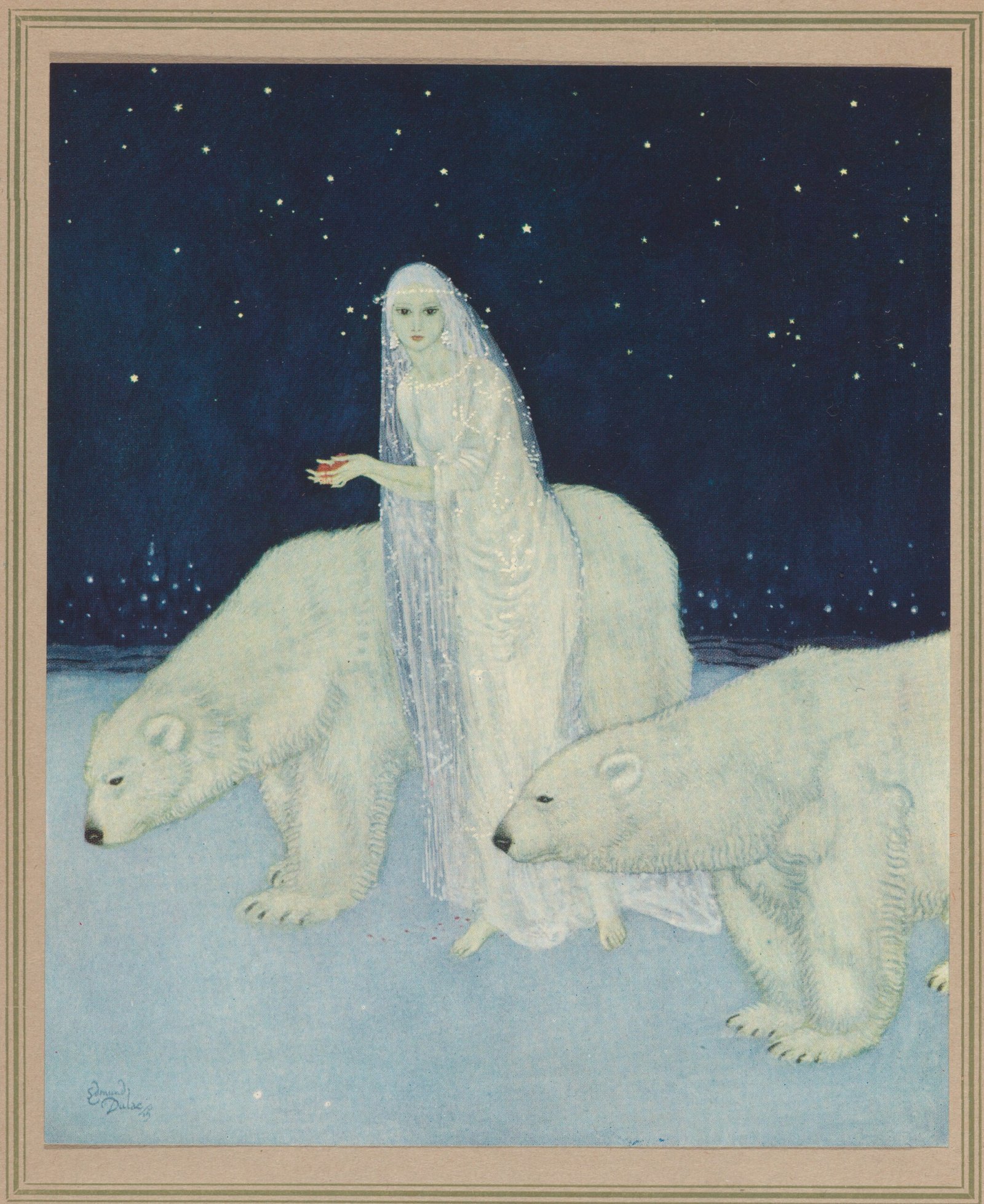
Edmund Dulac, the Ice-Maiden, from The Dreamer of Dreams, 1915. The pale dress, snow and bears form a connected family of colours. The figure’s upper silhouette becomes clearest against the dark sky.
Printed book illustration. Lowell 4230.53, Houghton Library, Harvard University, via Wikimedia Commons. Image record. Public domain.
Begin with the division between light and dark. The lower part of the picture is occupied by snow, pale animals and the woman’s long garment. Above it lies a broad field of blue. Her head and shoulders rise into that darkness, making the face easy to find without a large change of scale or an emphatic gesture.
Within the pale group, differences still matter. Small shadows give weight to the bears’ heads and paws. Fine vertical marks describe the falling dress. The ground holds them together while their shapes remain distinct enough to read. Dulac can keep much of the scene close in value because selected boundaries carry the necessary information.
The contrast between the bodies is equally useful. The woman is narrow and upright; the bears are broad and low. Her long, nearly vertical clothing interrupts their horizontal movement. They appear to accompany her, but their bulk also measures her fragility. The picture needs both kinds of shape to produce this particular procession.
Then the tiny red object changes our reading. According to Brighton & Hove Museums, which holds the original watercolour and gouache, this is a heart. In Queen Marie of Romania’s story, the maiden gathers broken hearts and takes them to her ice castle to warm them. What might first seem threatening belongs to an act of care.
The narrative is stranger and more tender than an initial glance can explain. Dulac gives that discovery an appropriate scale. The red is small enough to be noticed after the larger relationship between woman, animals and night. It rewards looking without taking over the picture.
Stars repeat the small bright notes scattered across the dress and veil. They connect the figure with the sky, while their spacing leaves the darkness largely intact. A night filled evenly with sparkling marks would offer a different experience. Here, there is room between them for the eye to rest.
The scene suggests one reason a dream may feel convincing: its elements seem to accept one another. The woman and the bears share a pace and a ground. We may not understand how they came together, but the picture does not show them disputing their place.
The Snow Queen: a figure made of her surroundings
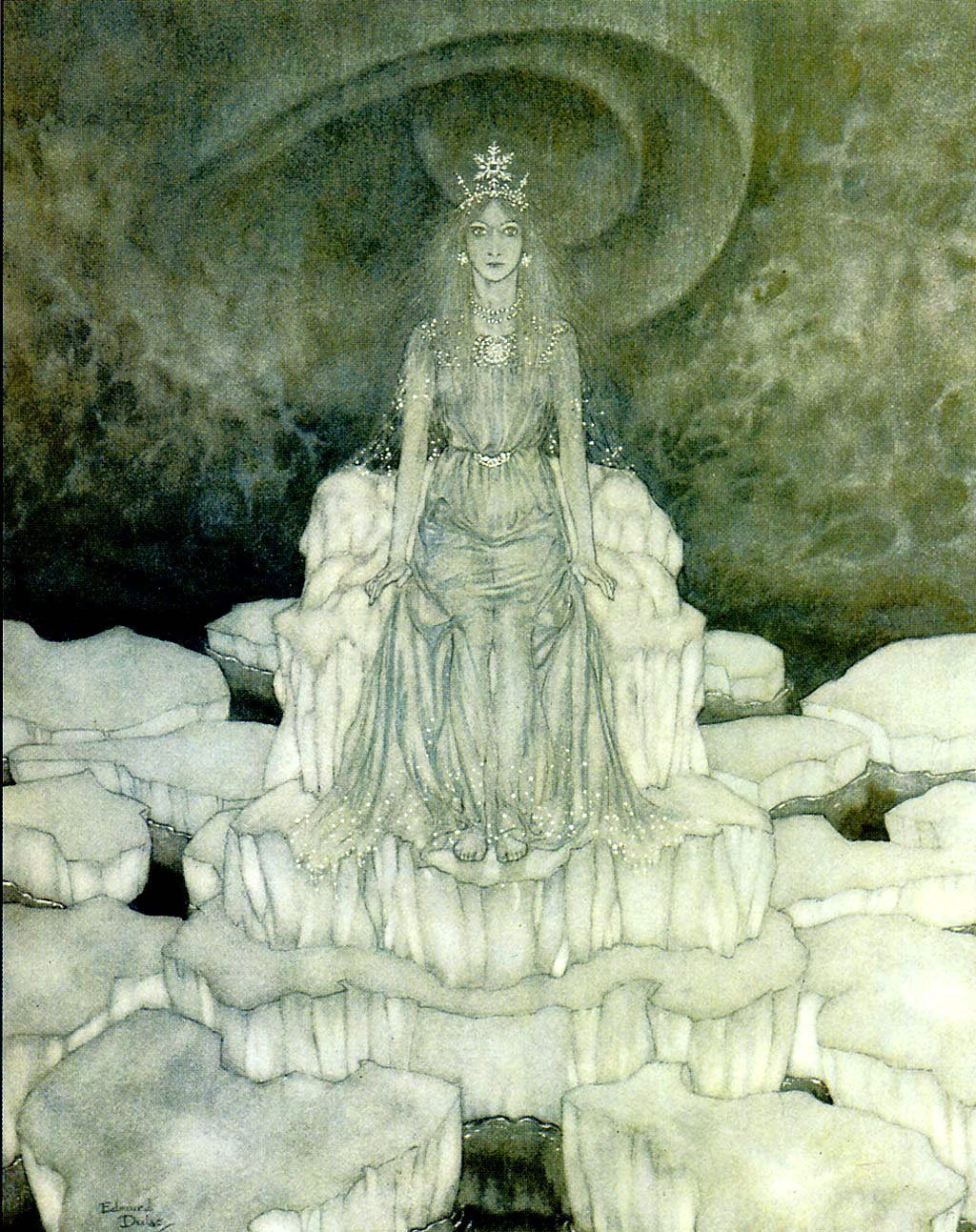
Edmund Dulac, the Snow Queen in her palace, from Stories from Hans Andersen, 1911. The upright figure provides a centre, while the pale dress and stepped ice repeat one another’s colour and downward shapes.
Printed book illustration, via Wikimedia Commons; source edition credited to Project Gutenberg. Image record. Public domain.
The Snow Queen offers another pale figure in a cold world, but the arrangement has changed. She faces forward, seated near the middle, with the tiers of ice spreading around and beneath her. Her dress falls towards the foreground. Instead of crossing the picture, as the Ice-Maiden does, she holds it in place.
Her stillness is supported by the construction below her. Broad shelves of ice lead from the lower edges towards the throne. Their changes of direction prevent the pale mass from becoming an undifferentiated pedestal. We can trace our way through them, from a nearer projection to another farther back, until the figure becomes the destination.
The surrounding atmosphere is much less straightforward. A large curling form moves through the dark area above her. The figure remains composed beneath it. That difference between a stable centre and a restless setting gives the scene a quiet tension: something moves, but she does not.
The dress participates in the ice. Its pale colour and long falling shapes echo the surfaces below, so the Queen seems to belong to the architecture rather than merely sit on it. Yet her face, crown and upright body still distinguish her. Too much separation would detach her from the palace; too little would make her difficult to find.
In Andersen’s tale, the frozen lake at the centre of the palace is associated with the Queen’s idea of reason. Knowing that adds an intellectual chill to the image, but the arrangement already communicates a kind of remote authority. We look towards a figure whose surroundings provide no obvious warmth or invitation.
Notice how little depends on a lively facial expression. The relation between figure and setting does most of the work. This is useful to remember when a painting feels emotionally undecided: its mood may be shaped by the space around the subject as much as by the subject itself.
The bubbles: weight below, release above
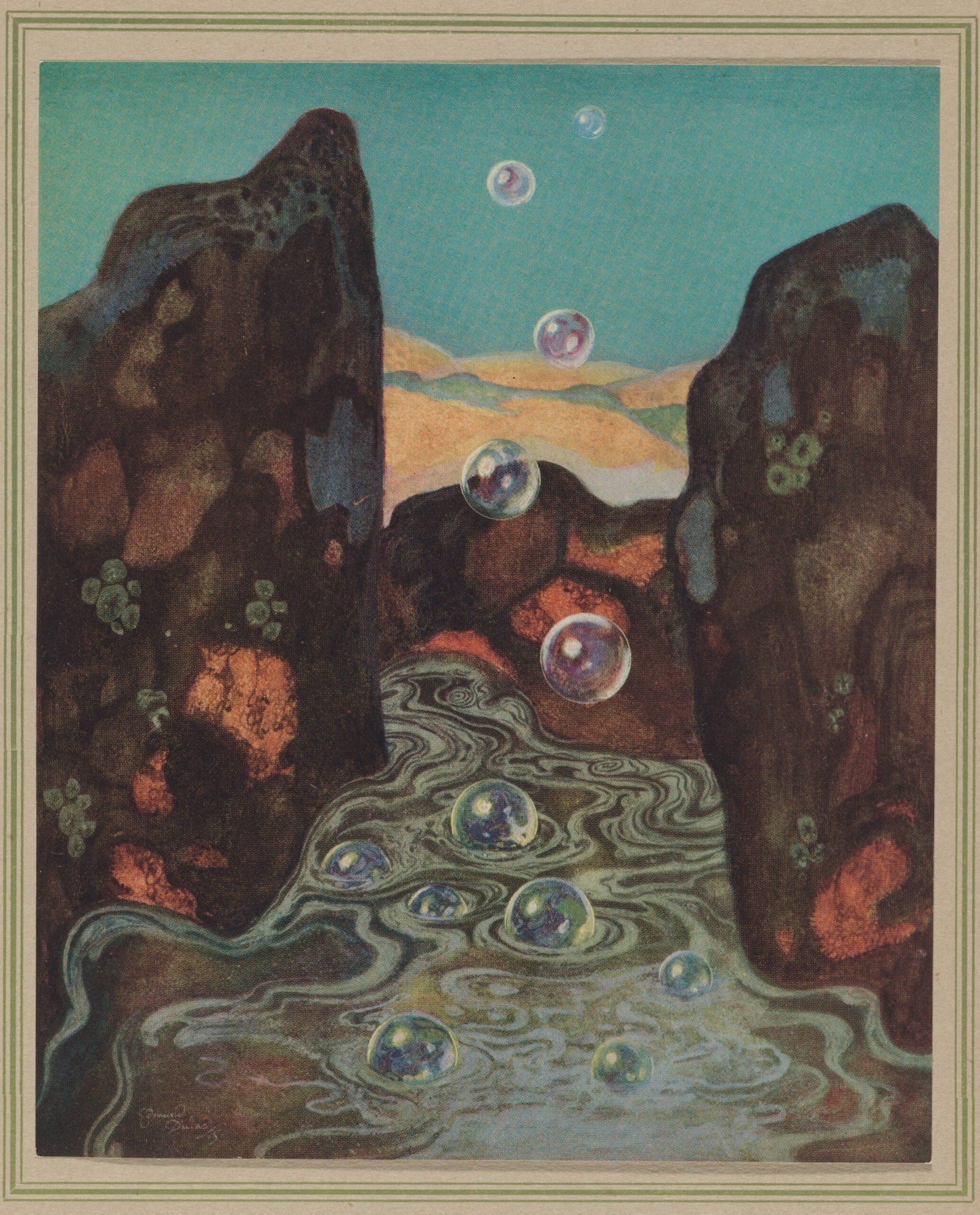
Edmund Dulac, It was the miraculous bubbles, from The Dreamer of Dreams, 1915. Dense rock shapes frame the rising spheres. The crowded pattern at water level opens into wider intervals above.
Printed book illustration. Lowell 4230.53, Houghton Library, Harvard University, via Wikimedia Commons. Image record. Public domain.
In the bubbles illustration, there is no prominent human face to organise our attention. The movement belongs to a series of circles. They gather near the water, rise between the rocks and become smaller and more isolated against the sky. The repeated shape provides a route through a landscape that otherwise feels heavy and enclosed.
The rocks on either side occupy substantial areas. Their irregular edges and dark interiors give the floating spheres something to rise between. Warm patches within the stone keep it from reading as an empty silhouette, but the masses remain heavier than the small, bright-edged forms in the opening.
Below, pale lines curl across the water. Their repetition produces a restless surface, full of turns and small enclosures. It would be easy for this pattern to dominate. The more regular circles of the bubbles offer a simpler shape to follow, and the comparatively quiet sky gives that movement somewhere to arrive.
The story supplies a remarkable explanation. In The Dreamer of Dreams, the artist Eric Gundian sees spirits enter a dark pool. The rising bubbles reveal their release. The scene turns the passage from confinement to freedom into something visible: enclosed water, an opening between rocks, then air.
Dulac’s illustration makes that journey readable through changes of density. The lower part contains more pattern and overlap. Higher up, individual bubbles have clearer space around them. We can read a release of pressure before knowing what the bubbles mean.
Their surfaces also complicate the landscape. Small coloured patches and bright edges make each sphere feel like a contained world. They repeat the larger picture’s interest in blue-green, warm colour and darkness, but gather those relationships into a compact form. A viewer can move from the whole setting to one bubble and back again.
For a painter, the important observation is the division of labour. The dark rocks establish weight. The water supplies activity. The circles supply continuity, and the sky supplies room. A painting can contain considerable detail when its parts do different jobs rather than compete for the same kind of attention.
The Mermaid: when the figure gives way
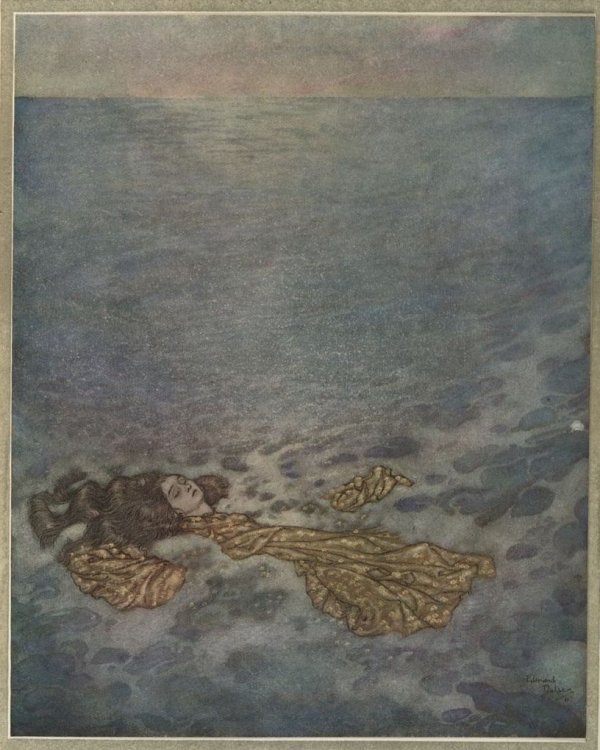
Edmund Dulac, the Mermaid dissolving into foam, from Stories from Hans Andersen, 1911. The face and patterned clothing remain legible while pale water interrupts the figure. The open sea above gives the intimate scene an expansive setting.
Printed book illustration, digitised edition from Project Gutenberg. Source edition. Public domain.
The Mermaid image turns the relationship between figure and environment in another direction. She lies low in the picture, her dark hair and patterned garment spread through the water. Above her is a large area of sea, then a narrow horizon and sky. The space is open, yet the scene feels more intimate than the frozen palace.
We find the face and the warm pattern of the clothing, then encounter pale foam crossing and interrupting the body. Some information remains distinct; other parts become difficult to separate from the surrounding water. That unevenness matters. A completely clear outline would describe a body lying on a surface. Here, the image allows the surface to take part in her disappearance.
The waves carry a rhythm of repeated marks. Near the figure they interact with hair, fabric and foam. Farther away, the water is less eventful. The movement from an intricate foreground to a broad expanse creates a distance that the small human presence cannot fill.
In Andersen’s story, the mermaid enters the sea and dissolves into foam; the tale then continues into a further transformation. Dulac’s plate holds the threshold. A still image can let us remain with an instant that the written narrative must eventually pass through.
There is sorrow in that suspension, but the composition avoids a crowded display of grief. No surrounding figures explain what we should feel. The patterned garment retains something of the human world, while the sea extends beyond it. The contrast in scale gives the event its loneliness.
The image also shows why dreamlike atmosphere cannot be reduced to pale colour or softened boundaries. Here, interruptions to the figure are central to the meaning. In the bubbles, distinct circular edges sustain it. Dulac varies the degree of clarity according to what is happening in the scene.
The same distinction matters in ordinary subjects. A boundary can be softened and still remain visible; an edge becomes lost when neighbouring shapes no longer separate clearly. Our guide to lost and found edges explores that difference. Dulac’s illustration gives it a narrative purpose: the figure’s changing visibility becomes part of the story.
A dream can have a clear shape
Taken together, these pictures resist one easy recipe. The Ice-Maiden depends on a pale procession against night. The Snow Queen holds a fixed position within a shifting setting. The bubbles rise through an opening. The Mermaid gradually joins the surface around her.
What they share is an arrangement that makes the unusual seem temporarily self-consistent. Each setting supplies conditions in which its subject can exist. The white bears and the woman share their cold palette. The Queen repeats the ice. The bubbles offer lightness between heavy walls. The foam interrupts a body at the moment the story requires it to change.
That is more useful than treating atmosphere as a final effect laid over an otherwise complete picture. It begins with what occupies the sheet, how large each part is and where the eye can move. Colour reinforces those decisions. Detail gives certain passages a reason to be examined closely, while quieter areas leave them room.
A dreamlike scene can therefore be built from careful observation. The weight of an animal, the fall of cloth, the outline of a rock and the spacing of marks on water all offer material for invention. What changes is how those recognisable things are brought together and what the picture asks them to mean.
Dulac’s world is worth visiting for its fantasy, but also for this discipline. Even where the narrative is extraordinary, the visible relationships are specific enough to discuss. We can point to the dark field behind a face, the opening between rocks or the expanse above a floating figure. The enchantment survives that attention.
What stays after the story
The Ice-Maiden’s face is small, but the night makes it present. The bubbles are fragile, but the rocks give their ascent weight. The Mermaid is disappearing, but a few distinct passages allow us to remain with her.
Dulac gives us enough clarity to enter each world and enough uncertainty to keep looking. For anyone painting with water, that is a generous proposition: atmosphere can emerge from precise decisions about colour, shape, space and what remains visible. The dream does not have to vanish when we look closely.