
Technique · Guide
Loose watercolour painting depends on selection. Keep the shapes, value relationships and small details that explain the subject, then give yourself freedom within them. A lively wash can wander; an important angle may still need to be right.
7 min read
A painting can contain hundreds of quick marks and still feel laboured. Another can have carefully drawn buildings and a few quiet washes, yet feel open and economical. Speed alone does not explain the difference. The question is how much each mark asks the viewer to notice.
If your paintings become tighter as you work, the answer may be to make fewer decisions on the paper. Choose what needs a clear statement before the wash begins. You can then leave some colour changes, broken marks and unfinished-looking areas alone because they do not threaten the picture’s main relationships.
At a glance
Keep the subject’s identifying shape. A roof pitch, a leaning trunk or the opening of a jug may matter more than surface detail.
Protect the important value relationships. Light and dark areas need enough separation to explain the form you want to show.
Give marks different jobs. A broad wash, a broken patch and a small accent should not all compete for attention.
Plan slowly enough to paint directly. A loose result can include drawing, drying pauses and deliberate corrections.
Stop for a reason. Before adding a mark, name the information it will supply.
Decide what the subject needs to remain itself
Begin with a specific observation. Perhaps the attraction is a narrow house leaning into a bend in the street, or a heavy tree crown over a slender trunk. Keep that relationship even if you leave out most of the windows or leaves. Otherwise simplification can turn a particular subject into a generic symbol.
Look for the few points that establish proportion and direction. On a house, these might be the ends of the roof, its ridge and where the wall meets the ground. On a seated figure, the tilt of the head and the relationship between shoulders and knees may carry the pose. These are useful places to spend time checking before painting.
You do not need to map every boundary in between. A small number of reliable drawing marks can give a broad brushstroke somewhere to begin and end. The guide to sketching before watercolour explains how much drawing to put on the sheet.
This is also why removing the pencil is not automatically a route to freer work. Drawing can supply the structure that lets the colour stay less descriptive.
Simplify inside the shape before changing its character
A tree’s irregular silhouette can tell us much about it while the interior remains a few joined areas of colour. A wall can keep its particular outline and shadow while its bricks disappear. Preserve the feature that distinguishes the subject before removing information elsewhere.
Watercolourist Eric Wiegardt makes a related distinction in his advice on getting lost in details: attention to the outside shape can support freer handling inside it. That is a useful starting point, especially when repeated small marks have replaced a clear form.
It is not a reason to outline everything. Some parts of the silhouette may need to disappear into neighbouring shapes. Keep enough to establish character, then decide which stretches can remain quiet. A loose painting can contain sharp boundaries; it does not need a soft edge around every object.
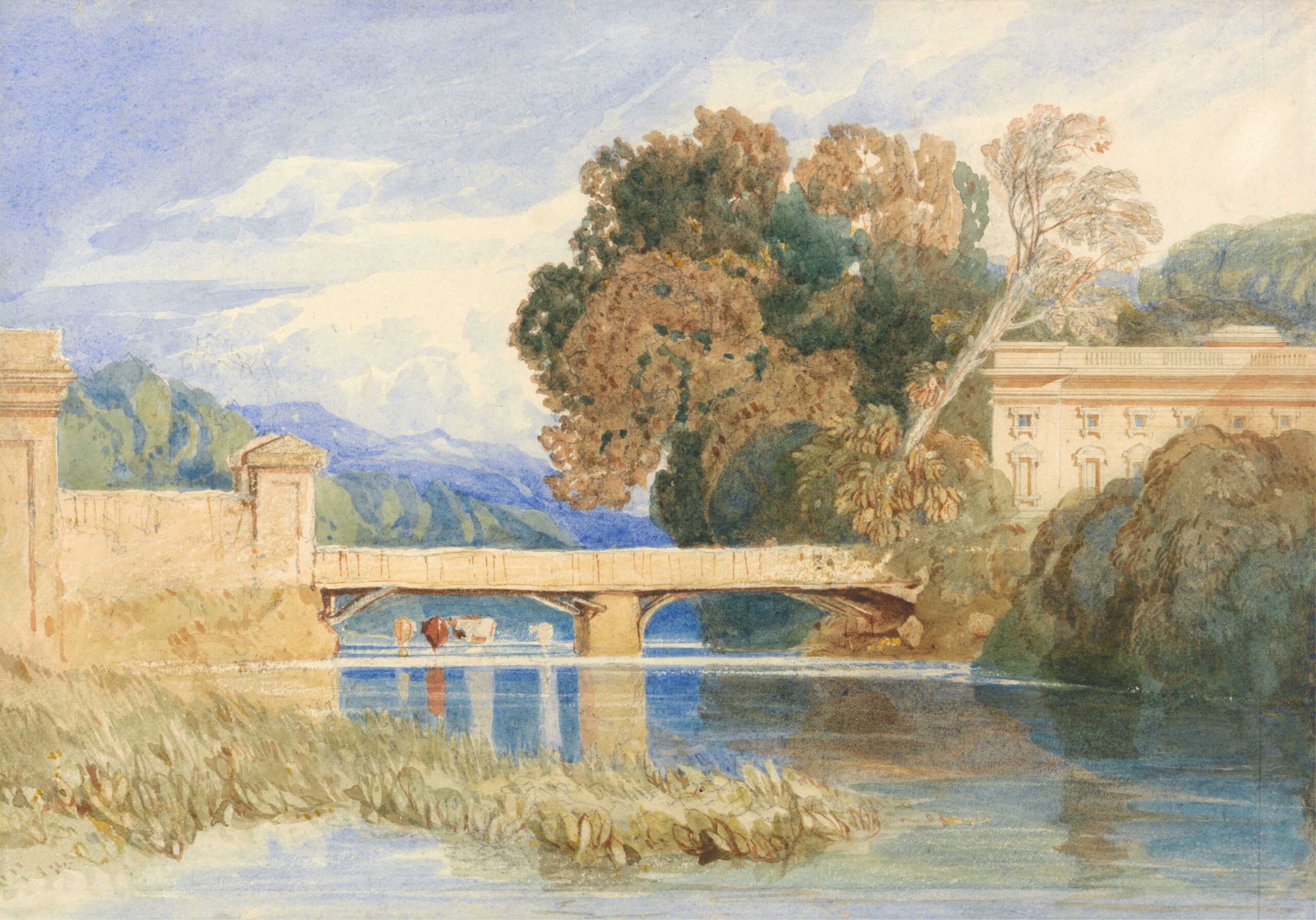
John Sell Cotman, Château Navarre, near Evreux, Normandy, about 1830. The long pale bridge and the broad tree mass remain easy to read among smaller foliage and grass marks. The bridge’s arches and straight upper edge carry more structural information than an inventory of individual leaves.
Watercolour and graphite on cream wove paper. Yale Center for British Art, Paul Mellon Collection, B1975.4.1631. Collection record. Public domain / CC0.
Keep the large light and dark shapes connected
Small details often make a painting tighter because each one introduces another division. A hedge that began as one dark area becomes a collection of separate leaves. A pale wall becomes a grid of windows, joints and stains. The original shape is still there, but it becomes harder to see through the competing marks.
Before adding detail, check the picture from farther away. Can you still recognise the main light, middle and dark areas? If a shadow should connect the tree to the ground, does it read as one area or as unrelated patches? The guide to working light to dark covers planning those value groups and their painting order.
Joining areas does not require a perfectly uniform wash. Colour and texture can vary within a shadow while it remains recognisably darker than the light beside it. That gives the paint room to move without asking every variation to describe a separate object.
Keep necessary separations, too. If the dark side of a jug disappears into its background and you need that side to explain the form, a clearer relationship may be more useful than further expressive marks.
Choose what to keep before choosing what to omit
Use the painting’s main idea to judge detail. The same feature can be essential in one picture and expendable in another. A window matters in a study of reflected light in glass; in a distant village, its exact divisions may contribute little.
| Subject | Information worth keeping | Information that can often be reduced |
|---|---|---|
| A house in sunlight | Roof direction, proportions and the main shadow shape | Individual bricks and repeated window divisions |
| A leafy tree | Crown shape, trunk direction and important openings | Repeated leaf marks inside an established mass |
| A seated figure | Pose, head position and the large clothing shapes | Small folds that repeat what the larger shapes already explain |
| A jug or bowl | Opening, width and the change from light to shadow | Decoration and small reflected variations unrelated to the main idea |
If you are working from a photograph, make these choices before translating every visible feature onto paper. The guide to painting from a reference photo develops that preparation in more detail.
Let edge variety do some of the describing
A firm edge can establish the rim of a bowl while the side fades into a nearby shadow. In a figure, a clear hat brim can help the head read even when the face contains little detail. One selected boundary can do the work of several smaller marks.
Make a distinction between an edge that is softened and one that is genuinely lost. A softened boundary remains visible as a gradual transition. A lost edge no longer reads as a separation. The guide to lost and found edges explains how neighbouring shapes produce that difference.
Use this variety where it helps the subject. Blurring an important angle can make the drawing uncertain, while a crisp mark in an otherwise quiet area may be exactly what the picture needs. Looseness does not require treating every boundary alike.
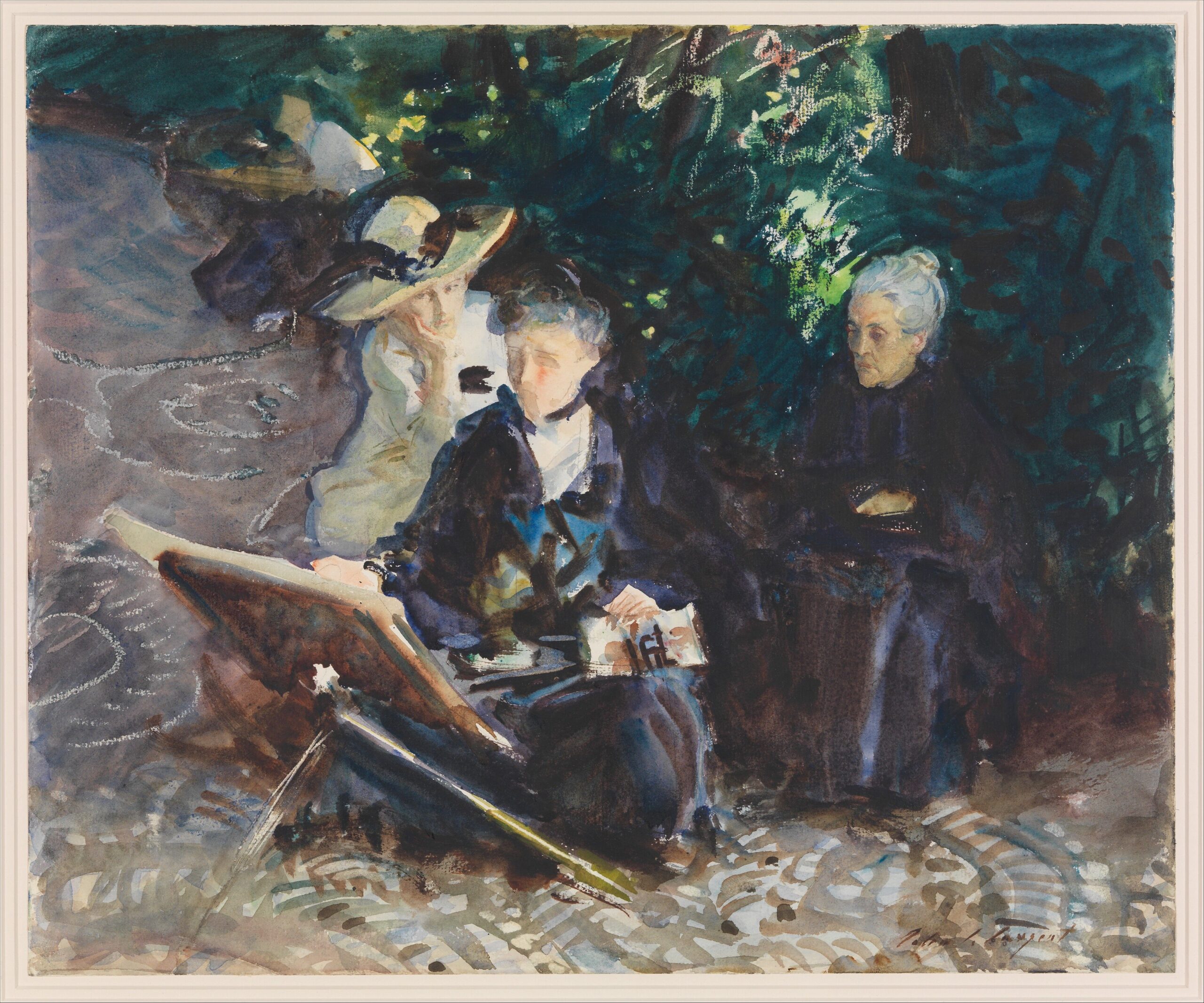
John Singer Sargent, In the Generalife, 1912. Faces, hats and hands remain readable within broad areas of dark clothing and foliage. Across the foreground, broken marks suggest the patterned ground without giving every tile an equally complete description.
Watercolour, wax crayon and graphite on white wove paper. The Metropolitan Museum of Art, Purchase, Joseph Pulitzer Bequest, 1915, 15.142.8. Collection record. Public domain / CC0.
Give the brush enough room to make a useful mark
Choose a brush by the area and shape you need to paint. If you have to assemble a broad shadow from many small strokes, a larger brush may help you carry it as a connected shape. But a brush that is too large to place the important boundary comfortably can create a different kind of hesitation.
Before touching the paper, identify the mark’s job and where it should stop. Place enough paint to describe the area, then look before returning to it. Repeatedly tracing the same perimeter can make a lively shape appear fenced in.
A small brush still has a place. A stem, a dark notch or the edge of an opening may need a narrow mark. The problem is giving every small feature the same emphasis, not the existence of small marks themselves.
Work with the paper’s timing
Freedom in a wash still depends on moisture. For colour to spread, the receiving area needs to be wet, with an even glossy sheen and paint still moving. A dry area allows a clearer stop. The guide to hard and soft edges covers how to choose between those conditions.
Once the sheen is lower or beginning to break, adding wetter paint or water carries a high risk of blooms. Do not try to recover spontaneity by repeatedly brushing water into a drying wash. Let it dry before deciding whether another layer is useful.
Pauses are part of direct painting. You can plan the next shape while one area dries, then place a distinct accent without disturbing what is underneath. There is no requirement to finish the picture in one wet sitting.
Recognise when another mark will make the painting tighter
Before adding detail, complete the sentence: “This mark will explain…” A change in plane, a necessary opening or the direction of a branch is a concrete answer. “It looks empty” is a reason to look again, not necessarily to fill the space.
Check three different problems separately. If the subject is unrecognisable, return to proportion and the identifying shapes. If everything looks equally busy, compare the emphasis of the details. If a once-clear wash is becoming disturbed, put the brush down and assess it after drying. These problems need different responses; more texture will not solve them all.
A dry painting may benefit from one carefully placed correction. It may also be more useful to carry a clearer decision into the next piece. The guide to fixing watercolour mistakes explains the limits of working back into the paper.
Keep the decisions clear and the description selective
A convincing loose painting gives the viewer enough information in the right places. Preserve the proportions, shapes and value relationships that carry your subject. Allow more variation where it will not confuse those relationships, and use detail where it adds something the broad shapes cannot say.
You can take your time over those decisions. The freedom comes when you no longer need every part of the painting to explain itself completely.