
Technique · Guide
A reflection is a different view, not a flipped picture. What water shows depends on its surface, where you stand and what lies above, within and beneath it. Read those relationships before choosing the marks.
8 min read
A reflection seems to offer a shortcut: paint the bank, then repeat it underneath. Sometimes a calm pond does look remarkably like a mirror. But copying the shapes on the page misses two things: the reflected view can reveal different parts of the subject, and a moving surface can break that view apart.
A tree might return as a clear shape in a sheltered pool and as scattered streaks a few feet away. The useful question is not how to make everything look watery, but what this particular stretch of water is showing. This guide covers inland and sheltered water seen from the shore. Breaking waves and open sea need separate treatment.
At a glance
A reflection is a view, not a flipped copy. It can show undersides and angles you cannot see directly.
Use vertical alignment as a starting point on calm water. Ripples can displace and break that alignment.
Compare values rather than applying a formula. Reflected lights often look darker; dark areas may also show colour from within or beneath the water.
Separate current from surface disturbance. Flowing water can still have a smooth, reflective surface.
A shadow is not a reflection. Reflections depend on your viewpoint; shadows depend on the light.
Read the surface before the reflection
Find a reflected vertical, such as a post, trunk or reed. If it holds its shape, that part of the surface is relatively calm. If it wavers or breaks into fragments, look for the disturbance responsible. A lack of clear reflections may also mean you are looking steeply down into the water, rather than across it.
Viewing angle changes the balance. In The Elements of Drawing, John Ruskin describes how looking down makes submerged objects easier to see, while a lower viewpoint gives reflections greater prominence. The underlying optical relationship is that a smooth water surface reflects a greater proportion of incident light at shallow viewing angles.
That helps explain why a river can look transparent near your feet and more reflective farther away. It does not determine the whole appearance: the brightness of the reflected scene, suspended particles and the bed also matter. Look for where you can actually see stones or weed, rather than painting a universal near-to-far colour gradient.
Place the reflection from water level
Ruskin offers a useful model: imagine the solid scene mirrored beneath the water, with each point the same distance below water level as the original is above it. View that imagined scene from where you are standing. The result is not necessarily the same as turning your drawing upside down.
On calm, level water, use vertical alignment beneath the source as your starting point. For a post standing in the water, the meeting point is easy to find. For a cottage set back on a slope, imagine the horizontal water plane continuing beneath the land. Its foundations may be above that plane, so the visible shoreline is not a hinge around which to flip the cottage. A bank can also hide part or all of its reflection.
The reflected view may reveal the underside of a bridge or an overhanging branch. James Gurney’s architectural example shows why perspective matters: corresponding horizontal directions retain their vanishing points, but the apparent slopes of edges in the reflected view can differ from those above it. Compare the angles you see rather than tracing a duplicate.
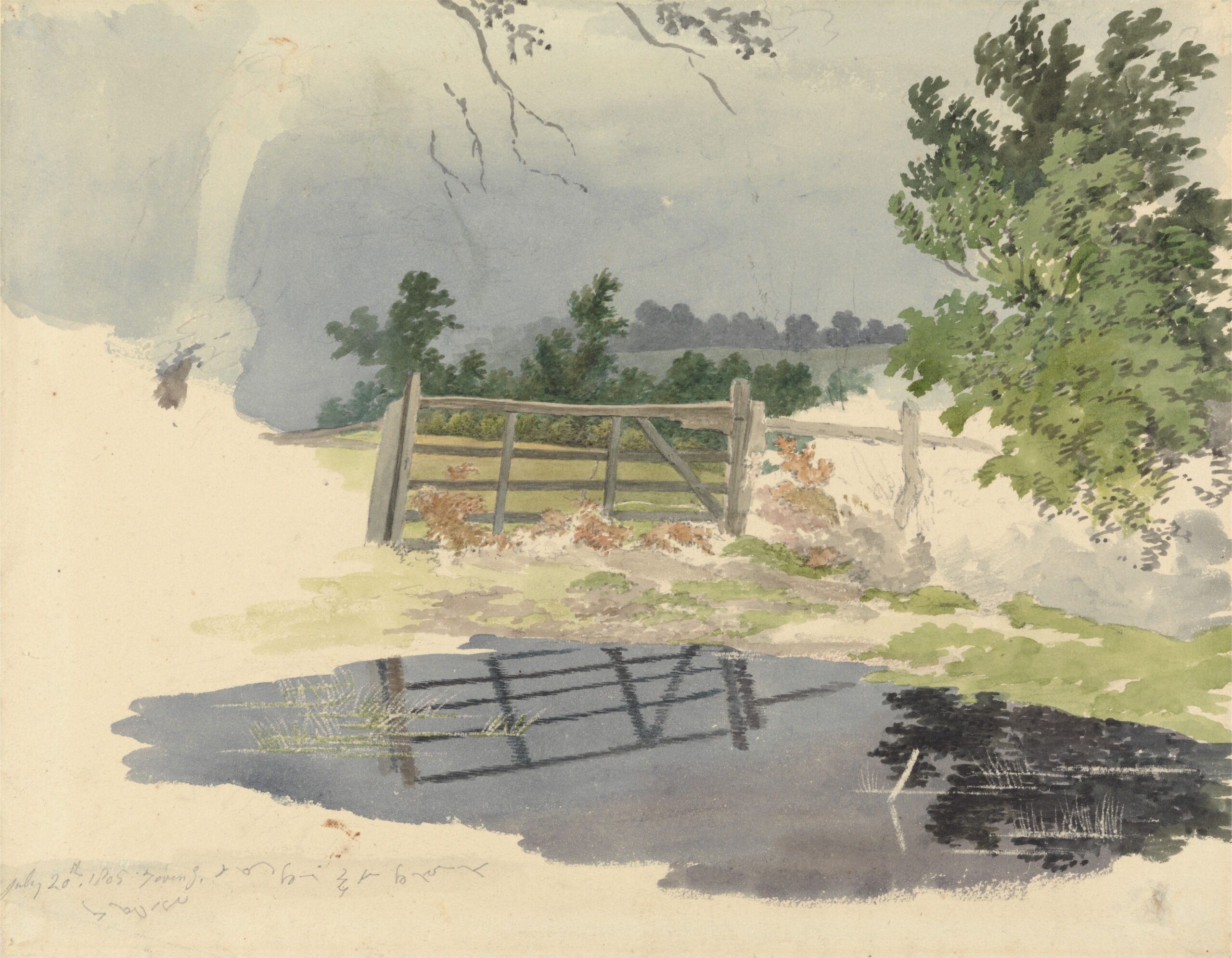
Robert Hills, A Gate Reflected in a Pool, 1805. The gate’s rails remain recognisable in the pool, but their angles and spacing differ from the view above. Small interruptions break the dark lines without hiding the structure.
Watercolour and graphite, with scraping out, on wove paper. Yale Center for British Art, Paul Mellon Collection, B1975.4.1697. Collection record. Public domain / CC0.
Compare the reflected values
Light objects often look darker in reflection because the surface returns only part of their light. That is a useful expectation, not a mixing instruction. Compare the reflected shape with the actual light and dark masses around it before deciding its value.
Darks are less predictable. Where a reflection is dark, colour from the bed or suspended matter can become easier to see. Gurney’s observations of illuminated, cloudy water describe dark reflections becoming lighter and browner. A dark tree above the water does not automatically require the same dark mixture below it.
Compare the reflected light and dark masses with the scene above, then paint the differences you actually see. Do not apply a fixed lightening or darkening formula. A reflection may be subdued, but a dark reflected bank against bright reflected sky can still make a strong contrast.
Colour follows the same reasoning. What you see can combine reflected light with light returning from within or beneath the water. A change in viewpoint alters that balance. Open water often returns sky colour, but check which part of the sky it shows rather than copying the strip immediately above the horizon. The guide to skies and clouds helps with reading those larger light and colour relationships.
Still water, ripples and turbulence
These conditions can sit beside each other: a calm pool beside a broken channel, or a smooth patch within a rippled lake. Flow and roughness are different things. A current can move through water whose surface remains comparatively smooth.
| Surface | What to look for | First painting decision |
|---|---|---|
| Calm and level | Coherent reflected shapes, sometimes with clear detail | Which shapes and boundaries carry the reflection |
| Rippled | Small tilted surfaces breaking and redistributing the image | The direction, apparent size and spacing of the interruptions |
| Broken or turbulent | Fragmented reflections mixed with foam, glints and changing surface shapes | The larger pattern of light and dark, before individual marks |
Still water: choose which detail matters
A calm reflection can be remarkably complete. Ruskin asked for nearly as much delicate drawing in the pool as above it. There is no need to contradict what you see by automatically blurring every edge or putting pale stripes across a still surface.
Choose what the painting needs to retain. A clear reflected trunk may establish stillness; a larger reflected tree mass may matter more than its separate leaves. Other boundaries can quieten where similar values meet. The guide to lost and found edges explains that choice without making softness a requirement.
When disturbances are present, place them deliberately. A line from a swimming bird or the current passing a stone can interrupt a reflection. Follow its observed curve and position rather than adding a standard set of horizontal strokes. Simplification is your choice about emphasis, not a claim that calm water cannot show detail.
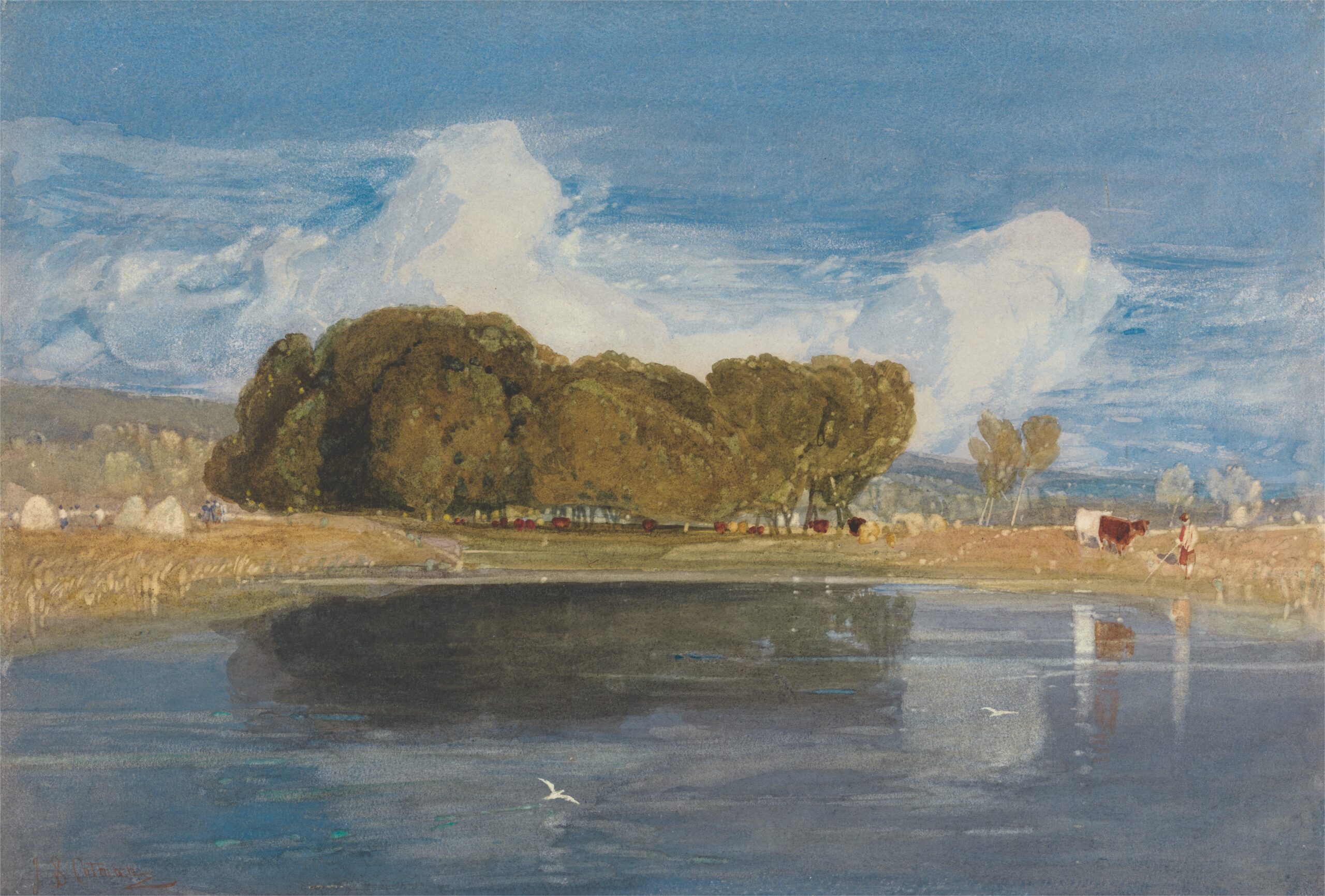
John Sell Cotman, A Summer Day, 1827 to 1837. The trees gather into a broad dark reflection, while the cattle and figure at the right remain distinct. Pale horizontal marks interrupt the water without dividing it into evenly spaced stripes.
Watercolour and graphite on wove paper. Yale Center for British Art, Paul Mellon Collection, B1977.14.4104. Collection record. Public domain / CC0.
Ripples: read the broken image
Small ripples can break a horizontal reflected edge while leaving a vertical recognisable as a sequence of fragments. In Modern Painters, Ruskin describes reflections extending down the water as sloping surfaces catch the image. He also notes that those slopes can deflect it sideways. Treat a vertical reflection as a guide to placement, not a rigid line that every fragment must obey.
A reflected post may therefore extend farther down the picture than it would on calm water, while a roofline becomes difficult to follow. Watch the arrangement of fragments as well as their individual shapes. The dark streaks and the lighter interruptions together describe the surface.
Where similar ripples continue into the distance, their apparent size and spacing diminish. Wind, shelter and current can change the actual pattern, so do not force the whole river into evenly graduated stripes. Preserve the broad change in scale while looking for local differences.
Strong lights can break into scattered glints or an elongated path. Decide which of these need to remain as paper before laying the wash. The guide to keeping whites compares ways to preserve small lights.
Turn those decisions into watercolour marks
Plan the broad colour and value areas first, including any connected reflection that needs to read as one shape. A flat wash is useful where an area is even; variation should follow what you see rather than being added simply to make the water lively.
Choose edge conditions before placing the reflected shape. For a spreading transition, the receiving area needs to be wet, with an even glossy sheen. A dry surface allows a more definite edge. Neither is the correct treatment for all reflections: use the guide to hard and soft edges to match the handling to the boundary you want.
Let a wash dry before adding separate, crisp accents that should not spread into it. A few dark fragments or pale gaps can establish the interruption without filling the whole water area with marks. Drybrush can suggest broken texture on dry paper, but its broken mark is not a substitute for observing the ripple’s shape. Stop adding accents while the large reflected masses still hold together.
Moving water: follow the surface, not just the current
Where water breaks around stones or over a change in level, stable reflections may give way to smaller, shifting shapes. Look for the larger pattern: where the flow smooths, where it breaks and where foam gathers. A few directional accents can distinguish these areas without describing every flicker.
Keep a reflection if it survives in a smoother pocket. Its contrast with the disturbed water can make both more legible. Flowing water does not need to be textured everywhere, and every mark need not point in the direction of the current.
Separate reflections, shadows and the bed
Three different things can appear in the same patch of water. A reflection changes with your viewpoint. On calm water its position can be checked against the object above; a disturbed surface complicates that relationship.
A cast shadow is governed by the light and the object blocking it. In clear, shallow water, you may see it on the bed. In cloudy water, reduced illumination of suspended particles can also make a darker area visible within the water. That area can cross a reflection without sharing its alignment. Do not give every dark shape the same explanation.
Stones and weed seen through the water are different again. Look at the shapes inside a dark area: are they parts of the reflected tree, or details on the bed showing through? Making that distinction before painting helps prevent a convincing shape from being placed in the wrong visual space.
Common problems
| What you see | What to check | A useful next decision |
|---|---|---|
| The reflection looks pasted beneath the scene | Its angles, values and interruptions have been copied without checking | Compare the reflected view separately; keep clear detail where the surface supports it |
| The water stands up like a wall | Bank perspective and the placement and scale of surface marks | Recheck the banks; reduce the apparent scale of comparable ripples with distance |
| A calm reflection seems to slide sideways | Alignment with the source and the correct water level | Recheck placement before adjusting texture |
| Ripples look like stripes | Marks repeat mechanically | Follow the actual disturbance and vary their apparent spacing and length |
| Dark shapes contradict each other | Reflections, shadows and the bed have been confused | Identify the light direction and which kind of shape each mark represents |
| Broken water looks rigid | Repeated marks describe neither a reflection nor a disturbance | Regroup the light and dark shapes, then retain only the accents that explain them |
Paint the surface the reflection sits on
Establish three things before painting: what the surface is doing, where the important reflected shapes sit, and how their values compare with the scene above. Let those decisions determine whether you need connected washes, clear edges or broken marks.
Keep the detail that explains the surface, whether that means a clear reflection on calm water or a few broken shapes on disturbed water. The aim is not to make the reflection less complete. It is to make the water convincing without giving every fragment equal attention.